Throughout time, many things come to peoples’ mind when the words “Christian” and “History” are combined in a sentence. There have been many wonderful things done in the name of Christianity, but also horrible things. “Christian History” isn’t always beautiful. It’s not just the story of rainbows, angels, and rising from the dead. There are so many aspects to it depending on who you are speaking to. But what truly is a Christian worldview of history? Is it proclaiming that the crusaders taking back the Promise Land from muslims during the First Crusade in 1099 was God’s purpose for the world? A better question might be why did God allow Jerusalem to be overtaken by muslims to begin with? Had the city never been overtaken, many Christians and nonbelievers lives would have been spared.
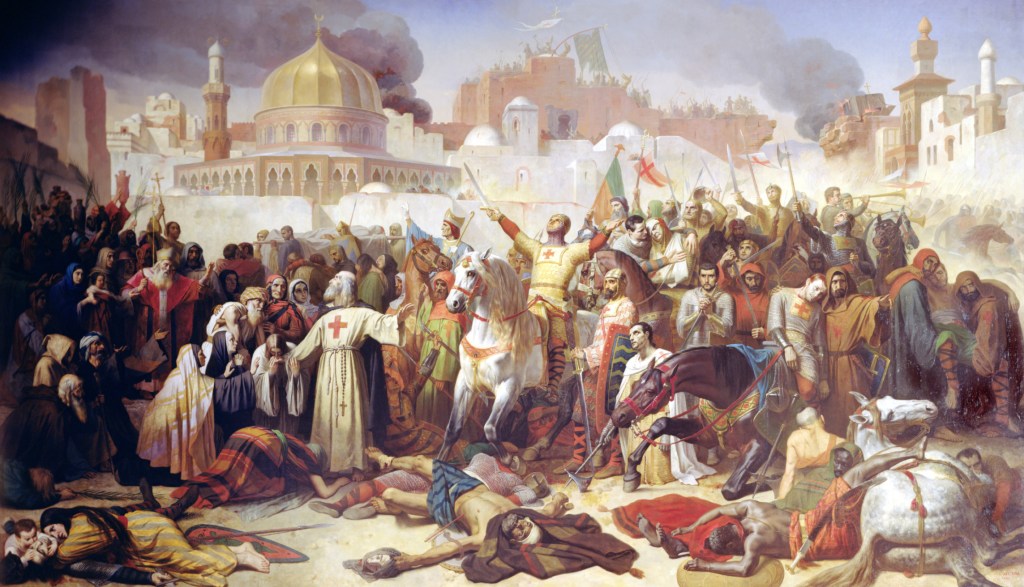
(Signol Emil. “Taking of Jerusalem by the Crusaders, 15th July 1099.” https://www.worldhistory.org/image/8983/taking-of-jerusalem-by-the-crusaders/)
Or is a christian worldview of history one that justifies the founding of the United States of America because the world needed a christian nation? Was England that bad at the time? Was not paying taxes worth the loss of thousands of mens’ lives? Some would argue, yes. I would say, no.

(Leutze, Emanuel. “Washington Crossing the Delaware.” https://en.wikipedia.org/wiki/George_Washington%27s_crossing_of_the_Delaware_River#/media/File:Washington_Crossing_the_Delaware_by_Emanuel_Leutze,_MMA-NYC,_1851.jpg)
A Christian worldview of history isn’t picking the best parts of history and stamping them with a “God Approved” stamp. It would be wonderful if that’s how it worked, but unfortunately it doesn’t. History isn’t about looking back and trying to label things with a “and that’s why that happened” because Christians want it to fit into a certain narrative. There are several problems with doing that, and I’ll attempt to explain a few.
First of all, as much as man wants to, we cannot divine the will of God. God’s divine will is not revealed to us. In Isaiah 55:8-9 (ESV), God says:
For my thoughts are not your thoughts,
neither are your ways my ways, declares the Lord.
For as the heavens are higher than the earth,
so are my ways higher than your ways
and my thoughts than your thoughts.
Modern day historians trying to look back into history and divine things that they simply cannot know is preposterous. It’s too many levels deep. Historians attempt to interpret the past with the little information they have but trying to add another layer on top by divining the will of God is something that is altogether impossible. No man knows the divine will of God.
Secondly, besides knowing what God intends for the end of time that is recorded in the book of Revelation, man doesn’t know God’s plan for each one of man’s lives. Going back to the earlier illustrations of the Crusades and the American Revolution, who is to say that either was part of God’s plan? How can a Providential Historian or a Whig Historian argue that either was a part of God’s will when both incidences caused much death and destruction and neither are living up to God’s moral standards to this day?
Finally, man’s ideas of God’s plans are not fully rooted in the Bible. Christians read Bible passages like Jeremiah 29:11 (ESV): “For I know the plans I have for you, declares the Lord, plans for welfare and not for evil, to give you a future and a hope;” and they assume that Christians are going to be successful and triumphant in this world, but that comes from a modernistic western worldview. They forget Jesus’ word in John 15:18-19 ( ESV): “If the world hates you, know that it has hated me before it hated you. If you were of the world, the world would love you as its own; but because you are not of the world, but I chose you out of the world, therefore the world hates you.”
Jesus himself promised persecution and hatred towards Christians, so why do people interpret great things happening for Christians as something God meant for them and bad things happening toward Christians something that Satan intended for them? Since the fall, God promised a Savior. Jesus Christ came and died for the sins of mankind, and He promised to return again and restore the earth to His glory, but until that time, mankind is destined to live in the interim and endure. Historians in the meantime like to translate every little thing that occurs as either part of God’s plan or not.
This is not a christian worldview of history. The protestant reformer, John Calvin believed a christian worldview of history comes from viewing history through a lens of scripture, just as christians should view everything else in life (Smith, “Christian Worldview and History”).

(https://sciencemeetsfaith.wordpress.com/2019/07/14/john-calvin-on-creation-and-scriptures/)
History, marriage, parenting, finances, discipline – all should be viewed through the written word of God. Anything taken out of that context doesn’t serve the greater good, and in turn is given a humanistic spin. By reading the scriptures and applying its doctrines to the rest of their lives, christians can view history through the lens of the Bible and through Jesus’ moral and ethical codes. Understanding that mankind is fallen and sinful but also image bearers of God can help historians interpret why mankind has done what it has done. By understanding that God works through the mighty and the lowly, historians can look back and see God’s work in big and small events through history. A christian historical worldview is important because it allows mankind to see their fallen nature but also God’s mercy throughout history and time. It prevents arrogance but also provides mercy. Christians can hold to the scriptures and God’s promises as they wait for his return. Historians can look back and interpret what they know through the word of God and present it unbiasedly to the present while understanding that mankind is both fallen by nature and saved by grace.
Bibliography:
Leutze, Emanuel. “Washington Crossing the Delaware.” https://en.wikipedia.org/wiki/George_Washington%27s_crossing_of_the_Delaware_River#/media/File:Washington_Crossing_the_Delaware_by_Emanuel_Leutze,_MMA-NYC,_1851.jpg
Science Meets Faith. https://sciencemeetsfaith.wordpress.com/2019/07/14/john-calvin-on-creation-and-scriptures/
Signol Emil. “Taking of Jerusalem by the Crusaders, 15th July 1099.” https://www.worldhistory.org/image/8983/taking-of-jerusalem-by-the-crusaders/
Smith, Dr. Samuel. Christian Worldview and History. Liberty University, 2014.
 Wandering Wallace
